
Is red light therapy the same as infrared? Not exactly. Red light therapy usually refers to photobiomodulation using visible red light and, in many modern devices, near-infrared light. Infrared therapy is broader: it may refer to near-infrared light used in photobiomodulation, or it may refer to heat-based mid- or far-infrared systems such as infrared saunas.
For spa owners, wellness clinics, recovery centers, gyms, distributors, and beauty equipment buyers, this distinction matters. Choosing the right red light therapy equipment for a spa or clinic is not just about using the word “infrared.” It is about understanding wavelengths, intended applications, device design, treatment area, cooling, irradiance, compliance, and client expectations.
Research and regulatory sources commonly describe photobiomodulation as a noninvasive light-based approach using red and near-infrared wavelengths, often in the red range of about 620–700 nm and near-infrared range above visible red light. However, the broader infrared spectrum extends much farther and includes thermal infrared wavelengths that are not the same as LED red light therapy.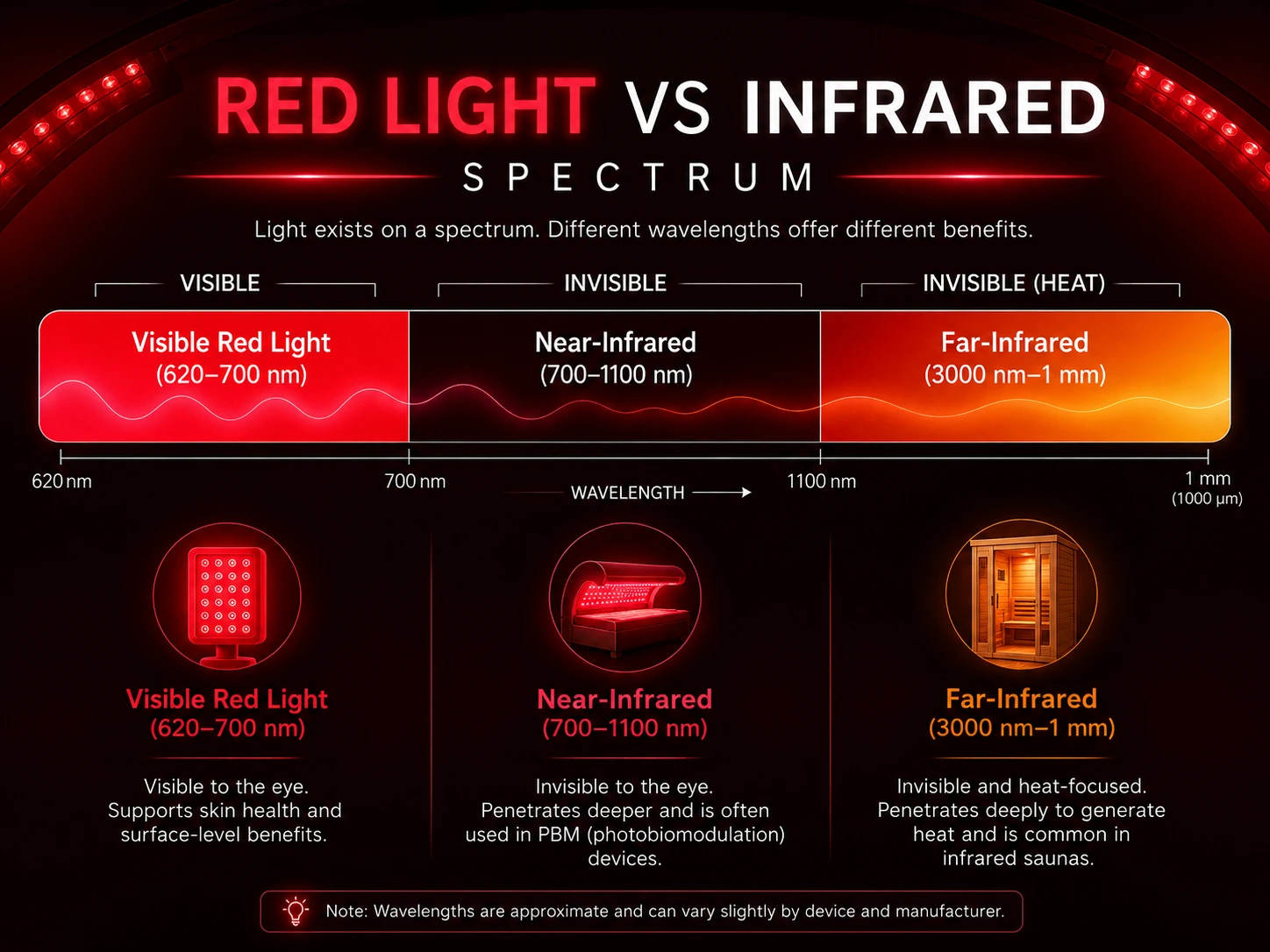
| Question | Simple Answer |
|---|---|
| Is red light therapy infrared? | Partly. Red light is visible, while near-infrared is invisible. Many red light therapy devices combine both. |
| Is near-infrared red light therapy the same as far-infrared therapy? | No. Near-infrared PBM devices and far-infrared heat systems work differently. |
| Which wavelengths are common in red light therapy? | Common commercial wavelengths include 633 nm, 660 nm, 810 nm, 830 nm, 850 nm, and sometimes 940 nm. |
| Is infrared always heat therapy? | Not always. Near-infrared PBM is often designed as non-thermal light exposure, while far-infrared systems are more heat-focused. |
| What should commercial buyers check? | Wavelengths, irradiance, LED layout, treatment coverage, cooling, safety features, supplier documentation, and target market compliance. |
Red light therapy is commonly used as a consumer-friendly term for photobiomodulation, or PBM. PBM uses specific wavelengths of light to interact with biological tissue. In the wellness, beauty, sports recovery, and rehabilitation equipment industries, red light therapy often includes both:
Visible red light, typically around 620–700 nm
Near-infrared light, often around 700–1,000+ nm depending on device design and classification
In commercial practice, the term “red light therapy” is often used even when the device also includes near-infrared LEDs. This is why buyers see product names such as:
Red light therapy bed
Red and near-infrared light therapy bed
PBM bed
Infrared red light therapy panel
Full-body red light therapy equipment
This naming can be confusing, but the key is simple: red light is visible; near-infrared is invisible; both may be used in red light therapy equipment.
Infrared light is electromagnetic radiation with wavelengths longer than visible red light. The International Commission on Non-Ionizing Radiation Protection describes infrared radiation as wavelengths above visible red light, from about 780 nm to 1 mm, and divides it into IR-A, IR-B, and IR-C bands.
Infrared is usually divided into:
| Infrared Type | Approximate Range | Common Commercial Association |
|---|---|---|
| Near-infrared / IR-A | Around 780 nm–1.4 μm | PBM devices, LED therapy, recovery equipment |
| Mid-infrared / IR-B | Around 1.4–3 μm | Heat and specialty optical applications |
| Far-infrared / IR-C | Around 3 μm–1 mm | Infrared saunas, thermal wellness equipment |
NASA also explains that infrared sits beyond visible light and can be divided into near-, mid-, and far-infrared regions.
This is why the phrase infrared therapy needs context. A clinic advertising “infrared therapy” may mean near-infrared PBM, far-infrared sauna therapy, infrared heat lamps, or another thermal wellness service.
The practical red light therapy and infrared therapy difference comes down to wavelength, visibility, heat, and intended use.
Red light is part of the visible spectrum. Near-infrared and far-infrared are invisible to the human eye. A red light therapy bed may glow red because of visible red LEDs, but its near-infrared LEDs may be active even when they do not visibly glow.
Many professional PBM devices combine red wavelengths such as 633 nm or 660 nm with near-infrared wavelengths such as 810 nm, 830 nm, 850 nm, or 940 nm. Magique Power’s product collection includes commercial red light beds and panels with red and near-infrared wavelength combinations for spa, gym, clinic, and OEM/ODM use.
Far-infrared equipment is commonly associated with thermal wellness systems, such as infrared saunas. That does not make it “better” or “worse,” but it is not the same technology category as a non-thermal PBM red light therapy bed.
A commercial red light therapy bed is often positioned for full-body PBM-style wellness, skin appearance, recovery, beauty, and relaxation programs. Far-infrared systems are more commonly positioned around heat, sweating, relaxation, and sauna-style experiences.
For commercial buyers, red light therapy wavelengths are one of the most important product specifications. Wavelength affects how light interacts with tissue, but it does not work alone. Dose, irradiance, session duration, treatment distance, beam angle, body area, and user consistency also matter.
| Wavelength | Category | Common Commercial Use Positioning |
|---|---|---|
| 633 nm | Visible red | Skin appearance, beauty, photorejuvenation positioning |
| 660 nm | Visible red | Skin, surface tissue, general PBM applications |
| 810 nm | Near-infrared | Recovery and deeper tissue positioning |
| 830 nm | Near-infrared | PBM research and professional recovery applications |
| 850 nm | Near-infrared | Common in commercial red/NIR panels and beds |
| 940 nm | Near-infrared | Often used in multi-wavelength professional systems |
Research reviews describe PBM as using red and near-infrared light, and note that parameters such as wavelength, energy density, power output, and exposure duration are central to device use.
A careful buyer should avoid choosing equipment based only on “more wavelengths” or “higher wattage.” Instead, evaluate whether the wavelength combination matches the service menu, whether the irradiance is measured properly, whether the LED distribution supports even coverage, and whether the supplier can provide technical documentation.
Near infrared red light therapy is popular because near-infrared wavelengths are widely used in PBM research and commercial device design. Compared with visible red light, near-infrared light is often discussed for applications involving deeper tissue targets, though penetration varies significantly depending on wavelength, tissue type, power, time, anatomy, and device parameters.
This matters for gyms, sports recovery centers, and rehabilitation-focused wellness spaces. A beauty salon may prioritize skin-facing red wavelengths, while a recovery center may prefer a commercial red light therapy bed that combines red and near-infrared wavelengths for broader full-body programming.
The better question is not red light therapy vs infrared, but which light technology matches your business model?
Visible red wavelengths are often used in facial, skin appearance, and beauty-focused red light services. A salon may choose panels, facial systems, or a full-body red light therapy bed if it wants to create a premium wellness experience.
A red and near-infrared system may be more attractive because recovery clients often look for whole-body sessions, muscle relaxation, and post-training wellness support. A bed or pod format may also increase perceived value compared with a small panel.
A full-body commercial red light therapy bed can support premium room design, membership packages, add-on services, and relaxation experiences. It also gives operators a clear story: visible red plus near-infrared wavelengths, noninvasive sessions, no sauna heat requirement, and minimal downtime.
The best equipment is not just the device with the most LEDs. Distributors should evaluate manufacturer stability, OEM/ODM capability, certifications, packaging, spare parts, training materials, branding support, wavelength options, and export documentation.
No. Far-infrared therapy is not the same as red light therapy.
Far-infrared systems are typically heat-based. Red light therapy beds and panels are usually designed around PBM-style exposure using visible red and near-infrared wavelengths. Both may be used in wellness businesses, but they should be marketed differently.
A helpful way to explain it to clients:
Red light therapy: “Light-based wellness using red and near-infrared wavelengths.”
Far-infrared sauna: “Heat-based wellness using infrared energy to warm the body.”
Near-infrared PBM: “A wavelength category often included in red light therapy equipment.”
A commercial red light therapy bed is designed to expose a large body area to controlled red and near-infrared light. Compared with handheld devices or small panels, a bed can create a more consistent full-body experience, especially for spas, gyms, wellness clubs, and clinics with repeat client traffic.
A professional bed may include:
Wavelength combinations such as 633 nm, 660 nm, 810 nm, 850 nm, or 940 nm
Large LED arrays for body coverage
Preset programs for common service workflows
Cooling systems for stable long-term operation
Touchscreen controls or timer settings
Protective eyewear protocols
Commercial-grade structure for repeated daily use
OEM/ODM branding options for distributors
Magique Power’s product and collection pages show red light therapy beds, panels, and full-body red/NIR equipment designed for commercial, wholesale, spa, gym, clinic, and OEM/ODM applications.
A spa or clinic can say:
“Red light therapy uses specific red and near-infrared wavelengths. Red light is visible, while near-infrared is invisible. Together, they are used in many professional PBM devices for noninvasive wellness, beauty, and recovery-oriented services.”
Cleveland Clinic describes red light therapy as an emerging treatment with promising areas of study, while also noting that more clinical trials are needed to confirm effectiveness for many uses.
Commercial buyers should treat red light therapy equipment as a professional wellness investment, not just an LED product.
Before purchasing, check:
| Area | What to Review |
|---|---|
| Eye safety | Protective eyewear, user instructions, contraindication guidance |
| Electrical safety | Certifications relevant to the target market |
| Claims | Avoid unsupported disease-treatment claims |
| Documentation | User manual, technical data, wavelength information |
| Cooling | Stable operation during repeated sessions |
| Supplier support | Warranty, spare parts, training, OEM/ODM service |
| Market rules | FDA, CE, local medical device, cosmetic, or wellness regulations |
In the United States, the FDA has issued draft guidance for photobiomodulation devices and describes PBM devices as also known as low-level light therapy devices, with certain PBM medical devices falling under Class II device regulations depending on intended use and product code.
For spas and clinics, this means wording matters. A device used for general wellness may be treated differently from a device marketed with medical claims. Always verify requirements in the country or region where the equipment will be sold or operated.
When evaluating red light therapy equipment for spa/clinic use, ask these questions:
Look for clear wavelength specifications. For example, red wavelengths such as 633 nm or 660 nm and near-infrared wavelengths such as 810 nm, 850 nm, or 940 nm.
Panels are flexible and space-efficient. Beds and pods create a premium full-body experience. Clinics may prefer beds for client comfort and consistent session positioning.
Ask how irradiance was measured, at what distance, and with what instrument. Be cautious with vague “high power” claims.
A large number of LEDs is useful only if the layout supports consistent coverage. Uneven hot spots or weak zones can reduce client experience.
For B2B buyers, supplier reliability matters as much as product appearance. Ask about replacement parts, warranty, packaging, training materials, private label, MOQ, lead time, and export experience.
Avoid suppliers that promise cures, guaranteed medical outcomes, or disease-specific results without appropriate clearance and evidence.
A commercial red light therapy bed can support memberships, session packages, recovery add-ons, beauty upgrades, or VIP wellness rooms. Calculate ROI based on realistic utilization, not idealized daily capacity.
| Business Type | Recommended Positioning |
|---|---|
| Beauty salon | Skin appearance, relaxation, premium facial/body add-on |
| Wellness spa | Full-body light wellness, relaxation, beauty recovery packages |
| Gym | Post-workout recovery service, membership upgrade |
| Recovery center | Red/NIR PBM-style sessions for active clients |
| Chiropractic or rehab clinic | Adjunct wellness service with careful claim language |
| Distributor | OEM/ODM red light therapy beds and panels for B2B buyers |
| Hotel or resort spa | Premium wellness room and guest experience upgrade |
They overlap in many devices, but they are not identical. Red light is visible. Infrared is invisible and includes near-, mid-, and far-infrared regions.
False. Near-infrared can be used in PBM, but far-infrared sauna therapy is more heat-based.
Not necessarily. PBM is often discussed as a non-thermal or low-thermal light interaction. Excess heat is not the main goal of professional red and near-infrared LED therapy.
Wattage is not the same as delivered light dose. Buyers should review wavelength, irradiance, distance, beam angle, exposure time, and coverage.
A regular red bulb is not the same as a purpose-built PBM device. Professional devices are designed around specific wavelengths, LED density, output, session control, cooling, and safety protocols.
Red light therapy is not exactly the same as infrared therapy. The most accurate answer is:
Red light therapy uses visible red light and often near-infrared light. Near-infrared is part of the infrared spectrum, but not all infrared therapy is red light therapy. Far-infrared heat therapy and red/NIR photobiomodulation are different categories.
For commercial buyers, this distinction affects equipment selection, client education, compliance, and service positioning. A spa or clinic looking for a premium noninvasive light-based service should focus on wavelength transparency, full-body coverage, stable output, supplier documentation, and realistic marketing language.
Magique Power offers commercial red light therapy beds, red/NIR panels, and OEM/ODM wellness equipment solutions for spas, clinics, gyms, recovery centers, distributors, and beauty businesses seeking professional full-body red light therapy equipment.
No. Red light therapy usually includes visible red light and may also include near-infrared light. Infrared is a broader category that includes near-, mid-, and far-infrared wavelengths.
Red light is visible and typically falls around 620–700 nm. Near-infrared light is invisible and begins beyond visible red light. Many PBM devices combine both.
Not always. It depends on the intended use. Red wavelengths are commonly positioned for skin and beauty applications, while near-infrared wavelengths are often included for broader recovery-oriented programs.
No. Far-infrared therapy is usually heat-based, while red light therapy beds and panels are typically designed for red and near-infrared photobiomodulation-style exposure.
Common professional wavelength combinations include 633 nm, 660 nm, 810 nm, 850 nm, and sometimes 940 nm. Buyers should also review irradiance, LED layout, cooling, safety, and supplier documentation.
For premium full-body services, a commercial red light therapy bed or pod may offer a stronger client experience than a small panel. Panels can still be useful for targeted treatments, smaller rooms, or lower startup budgets.
