
Red light therapy and hyperbaric oxygen therapy are increasingly visible in wellness centers, recovery studios, biohacking facilities, spas, and longevity-focused businesses. Both technologies may support premium service programs, but they operate through very different mechanisms and create very different client experiences.
Red light therapy uses selected wavelengths of visible red and near-infrared light. Hyperbaric oxygen therapy, commonly abbreviated as HBOT, combines increased atmospheric pressure with oxygen breathing.
So, when comparing red light therapy vs hyperbaric oxygen therapy, which technology is better?
There is no universal winner. The right choice depends on your target customers, service positioning, facility requirements, regulatory environment, staffing resources, and commercial objectives.
This guide compares the two technologies from both a technical and business perspective.
| Comparison | Red Light Therapy | Hyperbaric Oxygen Therapy |
|---|---|---|
| Core technology | Specific red and near-infrared wavelengths | Increased atmospheric pressure with oxygen breathing |
| Typical equipment | Panels, beds, pods and targeted devices | Soft-shell or hard-shell hyperbaric chambers |
| Primary energy input | Photonic energy | Pressure and oxygen |
| Typical client experience | Light exposure with little or moderate warmth | Resting inside a pressurized chamber |
| Common commercial positioning | Beauty, recovery, relaxation, performance and longevity wellness | Oxygen-based wellness, supervised recovery and certain medical applications |
| Space requirements | Depends on panel or full-body bed size | Usually requires space for the chamber and supporting equipment |
| Operational complexity | Generally straightforward after training | Requires pressure-system procedures, safety training and careful supervision |
| Session workflow | Often suitable for relatively short, repeatable sessions | Commonly involves pressurization, treatment and depressurization phases |
| Consumables | Usually limited | Depends on oxygen delivery system, masks, interfaces and sanitation protocol |
| Main purchasing factors | Wavelengths, irradiance, dose, coverage, cooling and controls | Pressure rating, chamber design, oxygen delivery, safety systems and compliance |
These are general comparisons. Actual session length, staffing needs and facility requirements depend on the device, its intended use and applicable local regulations.
Red light therapy is a widely used commercial term for photobiomodulation, or PBM. The technology exposes the body to selected wavelengths of visible red and near-infrared light.
Commercial red light therapy equipment may use wavelengths such as:
Some systems also offer additional wavelength configurations for specialized commercial programs.
PBM research suggests that red and near-infrared light may interact with cellular processes, including mitochondrial and redox signaling. However, the response depends on more than wavelength alone. Irradiance, delivered dose, treatment distance, exposure time, treatment area and device design all matter.
This is why a commercial buyer should not choose equipment based only on the number of LEDs or the highest advertised wattage.
Important specifications include:
Professional red light therapy beds are designed to provide exposure across a larger body area than a handheld unit or small panel. This can make them attractive to spas, gyms, recovery studios and wellness centers that want to offer a premium full-body experience.
Hyperbaric oxygen therapy uses increased atmospheric pressure together with oxygen breathing.
In a clinical HBOT setting, the patient typically breathes a high concentration of oxygen inside a chamber pressurized above normal atmospheric pressure. Increased pressure can raise the amount of oxygen dissolved in blood plasma.
However, the term “hyperbaric oxygen therapy” is sometimes used broadly in commercial marketing. A distinction must be made between medically supervised HBOT and lower-pressure systems marketed for mild hyperbaric or wellness applications.
The Undersea and Hyperbaric Medical Society defines clinical hyperbaric oxygen treatment more narrowly than many commercial advertisements. Exposures below certain pressure and oxygen thresholds should not automatically be described as equivalent to clinical HBOT.
Hyperbaric equipment can include:
In many commercial systems, the chamber itself is pressurized with air while concentrated oxygen is delivered directly to the user through a mask or similar breathing interface. The chamber should not automatically be described as being filled with oxygen.
The actual pressure, oxygen concentration, oxygen delivery method and intended use must be verified for each system.
The most important difference between red light therapy and hyperbaric oxygen therapy is how energy or oxygen is delivered to the body.
Red light therapy delivers photons at selected wavelengths. In PBM research, these wavelengths are studied for their interaction with light-sensitive cellular components and signaling pathways.
The treatment objective is not to heat the entire body or increase chamber pressure. A red light therapy bed may generate some warmth, but heat is not normally its primary mechanism.
Hyperbaric oxygen systems use a pressurized environment. Depending on the system, the user may breathe oxygen through a mask or other dedicated interface.
The combination of increased pressure and oxygen exposure distinguishes HBOT from standard oxygen concentrator use at normal atmospheric pressure.
Therefore, red light therapy and HBOT should not be treated as interchangeable technologies. One delivers selected wavelengths of light; the other changes the pressure and oxygen-breathing environment.
For a wellness business, the client experience may be as important as the underlying technology.
A commercial red light therapy session may involve:
A premium full-body system can also become a strong visual feature inside a spa, recovery room or biohacking facility.
A hyperbaric session may involve:
Some users may experience temporary ear pressure during pressurization, similar to changes experienced during air travel. Facilities need appropriate screening, instructions and supervision protocols.
For clients uncomfortable in enclosed spaces, chamber dimensions, windows, communication systems, internal controls and staff support can strongly affect the experience.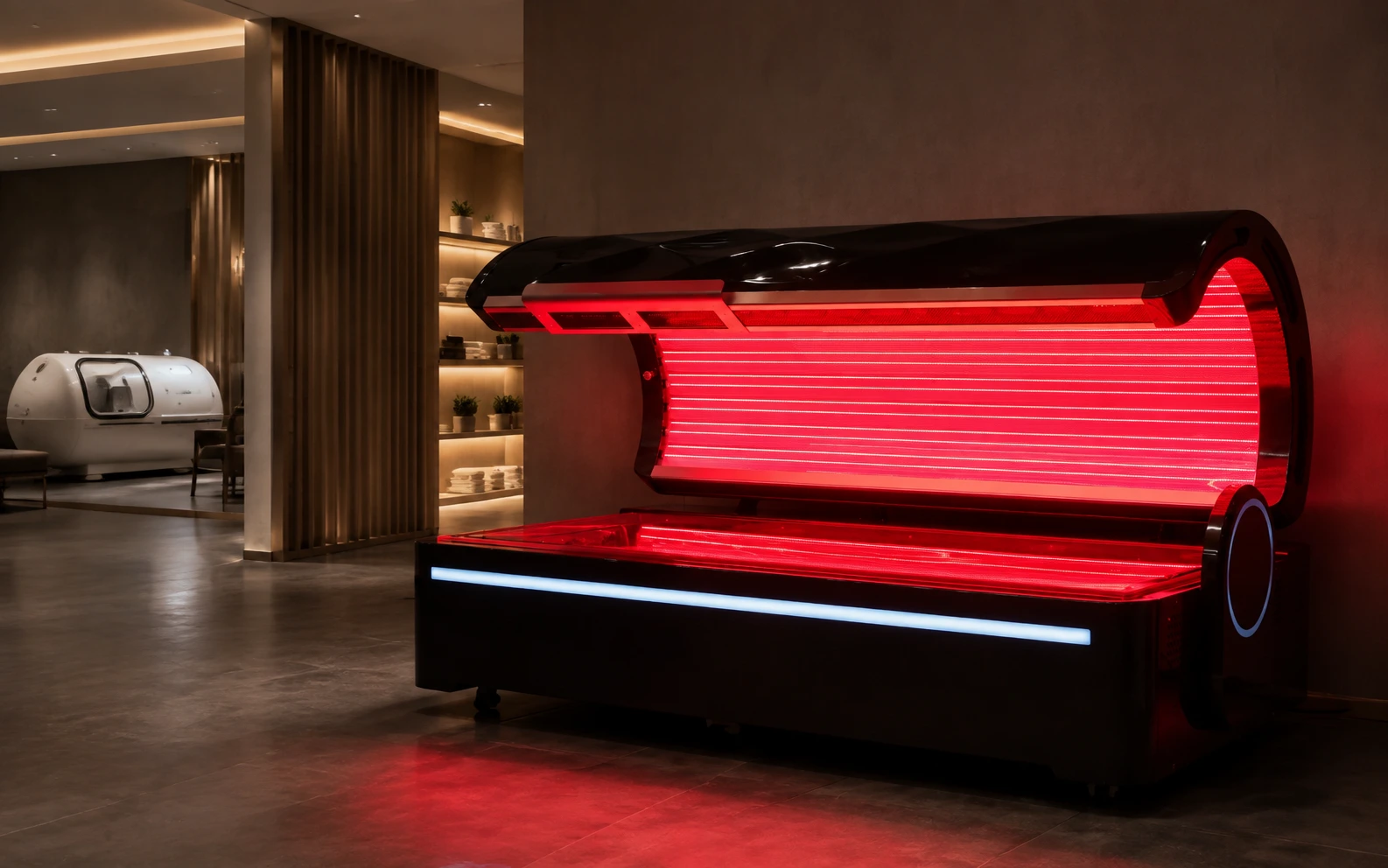
In many cases, red light therapy is easier to integrate operationally, but this must be evaluated against the specific equipment and local rules.
A commercial red light therapy bed generally requires:
A hyperbaric system may additionally require:
The FDA has emphasized following manufacturer instructions, maintaining staff training and implementing fire-prevention measures when using HBOT equipment. Requirements vary by country, pressure level, intended use and facility type.
Operators should confirm applicable requirements before purchasing or advertising either technology.
Red light therapy may offer a simpler workflow for businesses prioritizing relatively short sessions and frequent daily appointments.
A red light session does not require chamber pressurization and depressurization. This may make it easier to schedule between other services or include within memberships and recovery packages.
Hyperbaric sessions usually require additional time for:
However, it would be inaccurate to calculate revenue potential from session time alone.
Commercial performance also depends on:
Businesses should build their own financial model using verified equipment data rather than relying on generic ROI claims.
Red light therapy will often be the more natural first choice for a spa, med spa or beauty-focused wellness business.
It can be positioned around compliant, non-disease-related applications such as:
It may also fit more easily alongside facials, body treatments and other noninvasive services.
Hyperbaric systems can create a differentiated premium experience, but they introduce additional pressure-system, safety and facility considerations. A spa considering a chamber should first determine whether its intended service falls under wellness, medical or another regulated category in the target market.
Both technologies can be relevant to a recovery-focused business, but they serve different operational roles.
Red light therapy may be appropriate for facilities seeking:
A hyperbaric chamber may appeal to facilities seeking:
Neither technology should be promoted as treating sports injuries or medical conditions unless the specific device, intended use, evidence and local regulations support those claims.
Biohacking and longevity businesses often build their value around a portfolio of complementary technologies rather than a single device.
A facility might offer:
In this environment, red light therapy and hyperbaric systems do not necessarily compete for the same role.
Red light therapy can function as a relatively accessible, repeatable light-based service. A hyperbaric chamber can serve as a longer, higher-touch premium experience.
The best sequence for adding equipment depends on budget, space, staff capacity and the service model—not on unsupported claims that one technology is universally more advanced.
Some clinics and wellness businesses offer both technologies as separate parts of a broader recovery or wellness program.
Because red light therapy and HBOT operate through different mechanisms, they may be viewed as complementary from a service-design perspective. However, this does not prove that combining them produces superior clinical outcomes.
Evidence for a specific combined protocol may depend on:
Businesses should not claim that combining PBM and HBOT automatically accelerates healing, multiplies ATP production or produces a guaranteed synergistic effect.
When a combined protocol is offered, it should be based on device instructions, qualified professional guidance and the regulations applicable to the facility.
Before choosing either technology, request clear documentation from the supplier.
Review:
Review:
Certification claims should always be verified for the exact model, configuration and legal manufacturer. A general company certificate does not necessarily prove that every device has the same clearance or market authorization.
Red light therapy and hyperbaric oxygen therapy are not direct substitutes.
Red light therapy is a light-based technology that may be easier to integrate into spas, gyms, recovery studios and general wellness businesses. Commercial red light therapy beds can support relatively short sessions, full-body exposure and service programs spanning beauty, relaxation and recovery-oriented wellness.
Hyperbaric oxygen therapy uses increased pressure with oxygen breathing. It creates a more involved client experience and may require greater space, training, safety management and regulatory planning. Medical HBOT must also be distinguished from lower-pressure systems marketed for wellness use.
For many spas and recovery studios introducing their first advanced wellness technology, a commercial red light therapy bed may represent the more flexible starting point.
For specialized oxygen facilities, medically supervised centers or well-resourced longevity businesses, a hyperbaric system may support a differentiated service category.
For a comprehensive biohacking center, both technologies may have a place—but each should have a clearly defined role, evidence boundary and operating protocol.
The better investment is ultimately the technology that fits your customers, facility, compliance requirements and long-term business model.
No. Red light therapy uses selected wavelengths of red and near-infrared light. Hyperbaric oxygen therapy combines increased atmospheric pressure with oxygen breathing.
Not necessarily. The design varies. Some chambers use a pressurized air environment while oxygen is delivered to the user through a mask or other breathing interface. The exact configuration must be confirmed for the specific system.
It is generally less operationally complex, but professional equipment still requires training, eye-safety procedures, cleaning, maintenance and compliance with the manufacturer’s instructions.
Possibly, subject to local regulations, equipment classification, facility requirements and staff qualifications. The two services should be positioned accurately and should not be marketed with unsupported medical claims.
This has not been established as a universal conclusion. Some facilities offer both technologies, but the effectiveness and safety of a specific combined protocol require further verification.
Important factors include wavelength, irradiance, delivered dose, full-body coverage, cooling, controls, electrical requirements, safety instructions, warranty, certifications and supplier support.
Red light therapy may be the more flexible first investment for studios prioritizing shorter sessions and repeat membership use. Hyperbaric equipment may be suitable for businesses prepared for longer sessions and greater operational requirements.
This article is intended for general educational and commercial equipment-planning purposes. It is not medical advice. Equipment operators and buyers should follow the manufacturer’s instructions and consult qualified medical, safety and regulatory professionals where required.
